
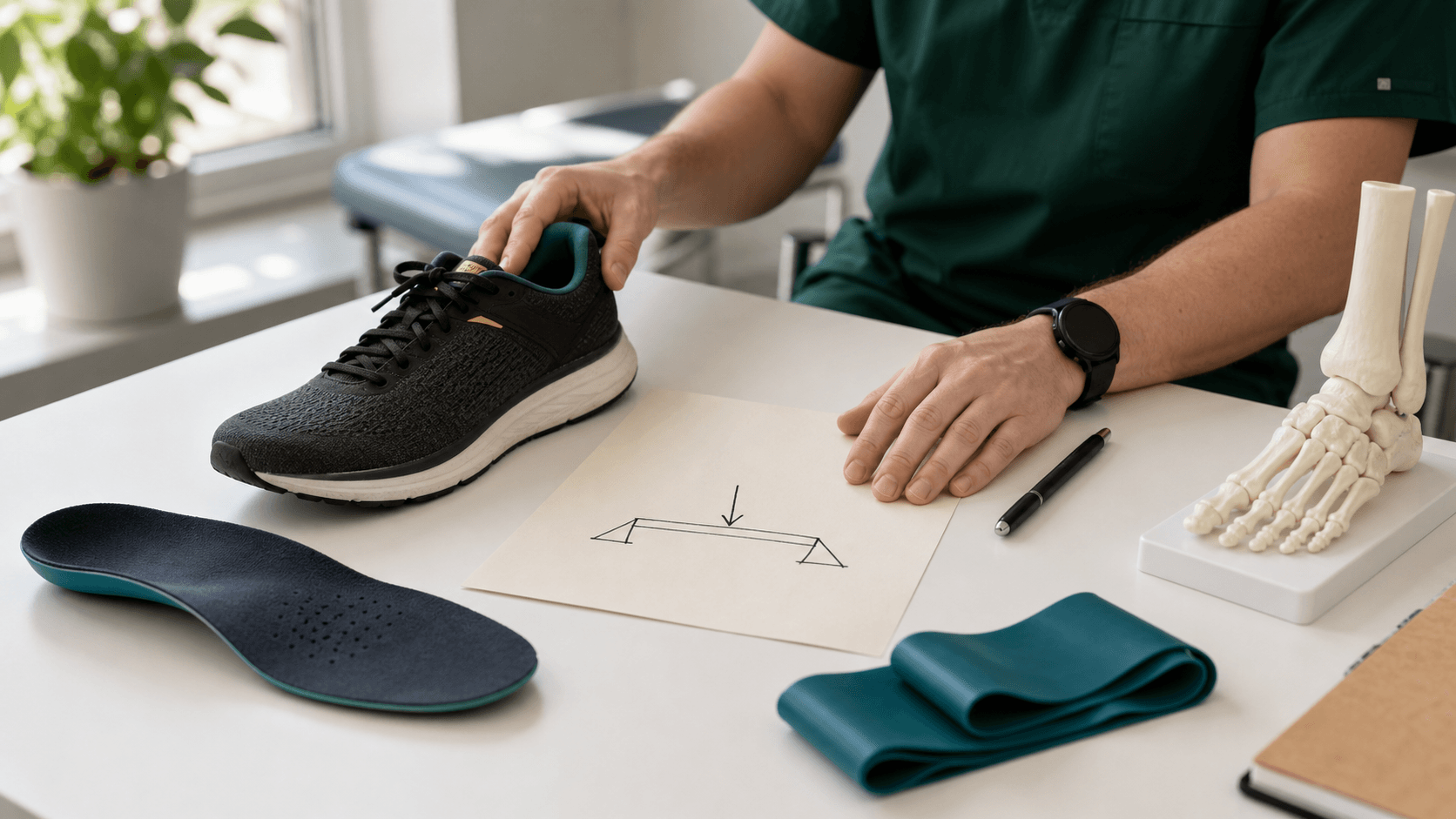
If a bridge starts creaking, you do not ask what is morally wrong with the bridge.
You ask what load it is carrying. You ask where the stress is going. You ask whether the structure can handle the job being asked of it.
Your body is not a bridge, obviously. It is much more interesting than that. But pain starts to make more sense when we stop asking, "what is wrong with me?" and start asking, "what is my body being asked to handle?"
That is the load and capacity framework we use at Pride Podiatry.
If your Achilles hurts, your Achilles is being asked to do something it does not currently like doing. If your forefoot hurts, something in your forefoot is being asked to tolerate a stress it is not coping with. If your heel hurts when you first get out of bed, the first few steps of the day are asking that tissue for more than it is ready to give.
That does not mean you are broken.
It means there is a problem we can understand.
Once we understand the load, the tissue, and your current capacity, treatment becomes much less mysterious. We can work out what to change now, what to build over time, and how to help you get back to the thing you actually care about doing.
Pain Feels Scary When It Feels Random
Pain gets much scarier when it feels like it has come from nowhere.
One morning your heel is sore.
Why? Good question.
It was not sore yesterday. Or was it? Maybe it was a bit stiff when you first stood up, but then it warmed up and you forgot about it. You went to work. You were on your feet. You trained after work. You cooked dinner. It was maybe a bit sore then, but not enough to stop you.
Then the next morning, bam.
There it is again.
Now your brain starts doing what brains do when they do not have a good explanation. It fills the empty space with increasingly dramatic possibilities.
Is this my life now?
Why is it stiff every morning?
Am I getting old?
Am I turning into my parents?
Is this how it starts before I end up talking about my knees at every family lunch?
That little spiral might sound ridiculous when you read it calmly on a screen. It does not feel ridiculous when you are standing beside the bed, half awake, putting weight through a foot that suddenly does not feel like yours.
The fear is not only the pain.
The fear is the randomness.
When pain feels random, it feels like your body has become unpredictable. And when your body feels unpredictable, it is very easy to jump from "my heel is sore" to "what is wrong with me?"
The Problem Is Usually A Mismatch Between Load And Capacity
Pain is a signal.
It is not a perfect signal. It does not tell us everything. But it is usually telling us that something in your body is not happy with what it has been asked to do.
When we are talking about feet, ankles, heels, tendons, joints, or bones, that "something" is often load.
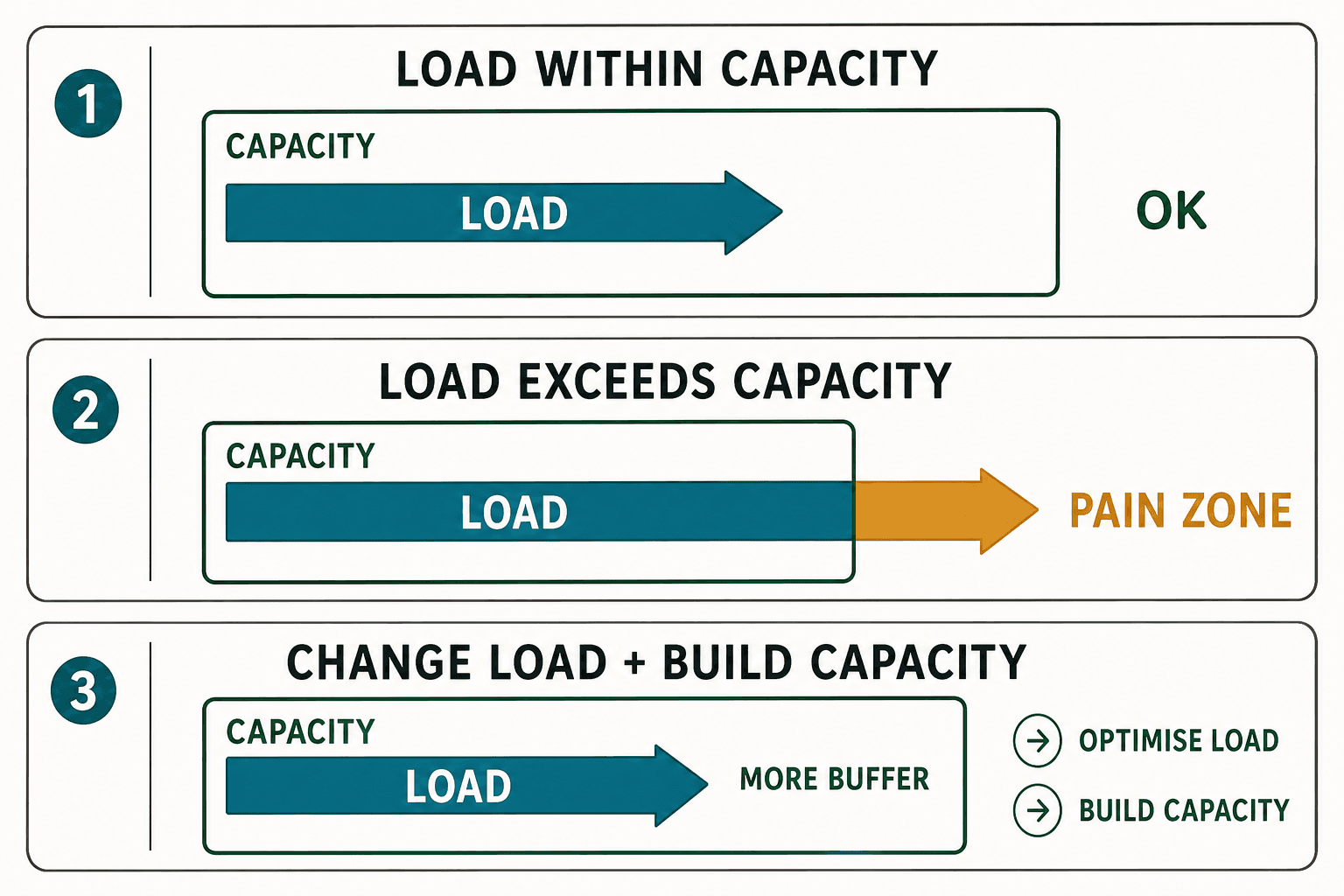
A tissue has been asked to handle a job that it does not currently have the capacity to handle.
That might not make sense at first. You might not feel like you have changed anything. You might be doing the same walk, the same run, the same gym session, the same workday, the same shoes, the same life.
And yet, suddenly, something hurts.
That can happen because capacity can change. It can also happen because the type of load has changed in a way that is not obvious.
Not all loads are created equal.
The pressure under your forefoot is not the same as the pull through your Achilles. The first few steps in the morning are not the same as the tenth kilometre of a run. Standing all day in work shoes is not the same load as doing calf raises in the gym, even if both involve your feet.
When there is a mismatch between the capacity of a tissue and the type, amount, or timing of load going through it, you have a problem.
The good news is that it is a problem we can work with.
We can find the tissue. We can work out the load. We can see what capacity is missing. Then we can decide what to change first.
Load Is The Job Your Body Is Being Asked To Do
Your feet do a ridiculous amount of work.
They are not passive pads at the end of your legs. They are shock absorbers, springs, levers, adaptors, sensors, and stabilisers. They have to be mobile enough to adapt to the ground, stiff enough to push you forward, strong enough to hold you up, and springy enough to help you move efficiently.
No pressure, little feet.
Each foot has 26 bones. Between both feet, that is roughly a quarter of the bones in your body. Then add the joints, tendons, ligaments, muscles, nerves, skin, fat pads, and all the small structures that need to work together every time you stand, walk, run, jump, lift, or change direction.
That is load.
Load is the job your body is being asked to do.
Sometimes that job is obvious. You went for a longer run. You started F45. You walked 18,000 steps around the city. You spent all day standing at work. You wore the beautiful shoes that make your forefoot quietly question your life choices.
Sometimes the job is less obvious.
It might be the speed you ran, not just the distance. It might be the hill, not just the walk. It might be the shoe, the surface, the number of stairs, the extra incidental steps at home, the harder gym block, the way you push off through your big toe, or the way your Achilles is being asked to work in a lower-drop shoe. If running or sport is the thing that keeps exposing the problem, a sports podiatry assessment can help connect the symptom to the actual load.
And the numbers can get wild.
Your Achilles can be asked to handle several times your body weight when you walk, run, or jump. Your forefoot can take huge loads during running and push-off. Your big toe joint is not just a little hinge sitting there politely. It is one of the key joints that helps you roll over the foot and propel yourself forward.
So when we talk about load, we are not only talking about "activity".
We are talking about the specific job being asked of a specific tissue.
How much?
How often?
How fast?
In what shoe?
On what surface?
In what position?
With what recovery?
And, most importantly, is that tissue built up enough right now to handle that job?
Capacity Is What Your Body Can Currently Handle
Capacity is what your body can currently handle and recover from.
If you go for a walk, get home feeling energised, sleep normally, and wake up the next morning feeling fine, brilliant. Your body handled that load.
If you go for a run, play footy, do a gym session, or spend a long day on your feet and your symptoms behave well during and after it, that tells us something useful. It does not mean your body is invincible. It means that, on that day, with that dose, your capacity was enough.
Problems start when the same kind of load starts to hurt.
Or when it feels okay at the time, then bites you later.
That later bit matters.
A lot of foot and tendon pain is not judged only by what happens during the activity. It is judged by how the tissue behaves afterwards. Does it settle? Does it flare that night? Is it worse the next morning? Does the first step out of bed feel like your heel has been replaced by a small, angry rock?
Morning pain is often a clue that something from the previous day, previous few days, or previous few weeks has exceeded what that tissue can currently tolerate.
Sometimes the story is obvious. You pushed hard for an event. You walked twice as far as normal. You went back to netball after a long break and expected your body to remember 2017. It did not.
Sometimes it is less dramatic.
Capacity can drift down quietly.
You miss strength training for a few months. Work gets busy. Sleep gets worse. Stress goes up. Your walking stays the same, but the system underneath is not getting the same recovery or training input. Then one day, the same old load is no longer the same old load to your body.
That is why capacity is not just "fitness".
It is strength, recovery, sleep, stress, training history, tissue tolerance, confidence, and how well your body is prepared for the job you want it to do.
But I Haven't Changed Anything
This is one of the most common things we hear.
"But I haven't changed anything."
And often, that feels true.
You did not start a marathon program. You did not fall down stairs. You are just living your life, doing your usual things, and suddenly your heel, Achilles, forefoot, knee, or ankle has decided to become a main character.
Sometimes, though, there has been a change. It is just not the change you were looking for.
Your shoes might have compressed, warped, softened, or lost the shape that used to help you. The same shoe on the outside may not be doing the same job underneath you.
Your workday might include more incidental walking. Your commute might have changed. Your training might include more hills, speed, jumping, or fatigue than you realised. Your recovery might be worse because life has been doing that charming thing where it asks for more and gives you less sleep in return.
Other times, the change is inside.
Strength changes. Elasticity changes. Tissue tolerance changes. Balance changes. Recovery changes. The capacity you had a few years ago is not automatically the capacity you have now.
That is not a character flaw.
It is just biology, physics, and time having a meeting without asking your permission.
The useful question is: what are you doing to resist that drop in capacity?
For most adults, one of the big answers is resistance training. Muscles, tendons, and bones generally need meaningful load to maintain and build capacity. Not just steps. Not just being busy. Load that asks the system to stay strong.
Australian physical activity guidelines recommend muscle-strengthening activities on at least 2 days per week. But the Australian Institute of Health and Welfare reported that in 2022, 73% of Australian adults aged 18-64 did not meet that guideline. For adults aged 65 and over, 84% did not meet it.
So if you are in your 40s, 50s, or 60s and thinking, "I have not changed anything," you may be right.
But your capacity may have changed anyway.
Your daily load may have stayed roughly the same while your ability to handle it has quietly dropped. Eventually, the day-to-day stress outstrips the capacity underneath it.
That is when you enter the pain zone.
And that is often when people start searching for answers.
This Is Where The Physics Gets Useful
I love physics because physics is undefeated.
You cannot negotiate with it. You cannot inspirational-quote your way around it. You cannot tell a tendon that it should be fine because you have a busy week and really need it to stop complaining.
You can only understand the forces, then work with them.
This is where load and capacity becomes practical.
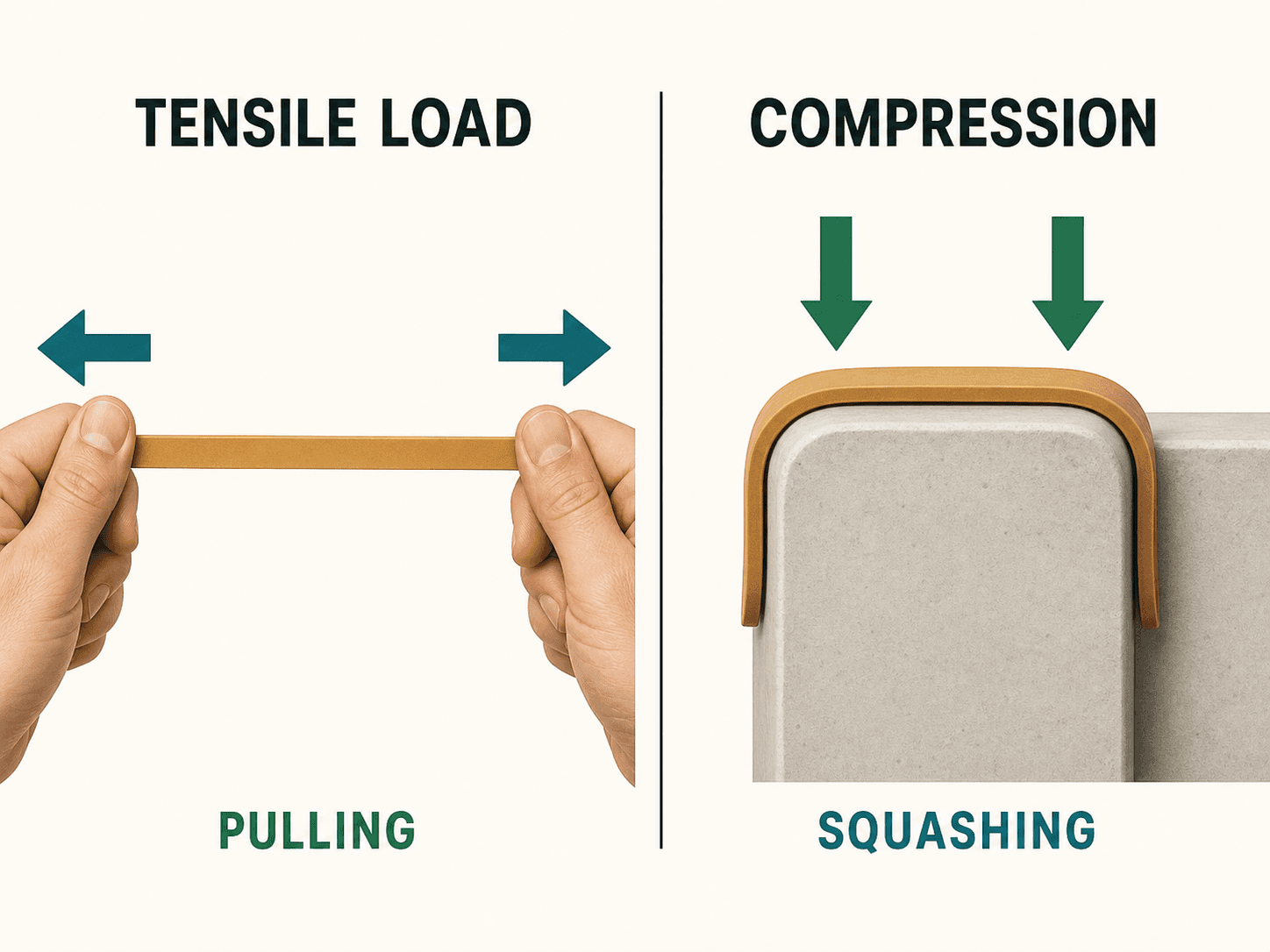
Different tissues like different kinds of stress.
Bones love compression. They are built to deal with being loaded, pressed, and strengthened by the right kind of weight-bearing force.
Tendons love tensile load. Pulling load. Spring load. The kind of load that asks them to stretch, recoil, and help you move.
But tendons hate compression, especially when they are already sensitive. Squash a tendon against bone, wrap it around a corner, or combine compression with a big pulling load, and that can be a very different job from the one it likes best.
This is why "load" is not one thing.
Imagine an elastic band.
Pull it lengthways and it behaves one way. Twist it, squash it, fold it over the edge of a table, and it behaves differently. Same object. Different force. Different response.
Your body is more complex than an elastic band, but the principle is useful.
If your Achilles is sore, we want to know whether it is being asked for too much pulling load, too much compression, too much speed, too much hill work, too much stretch, or some messy combination of those things. If that is the pattern you are dealing with, Tendon Time is the course we built to help you think more clearly about tendon load before you keep guessing.
If your forefoot is sore, we want to know whether a small area is being compressed too much at push-off, whether your shoe is adding pressure, whether your big toe joint is doing its job, and whether the tissues underneath the ball of the foot have the capacity to tolerate the load.
If your bone is sore, we need to respect that repeated stress without enough recovery can become a much bigger problem.
That is the useful part of physics.
It gives us something to change.
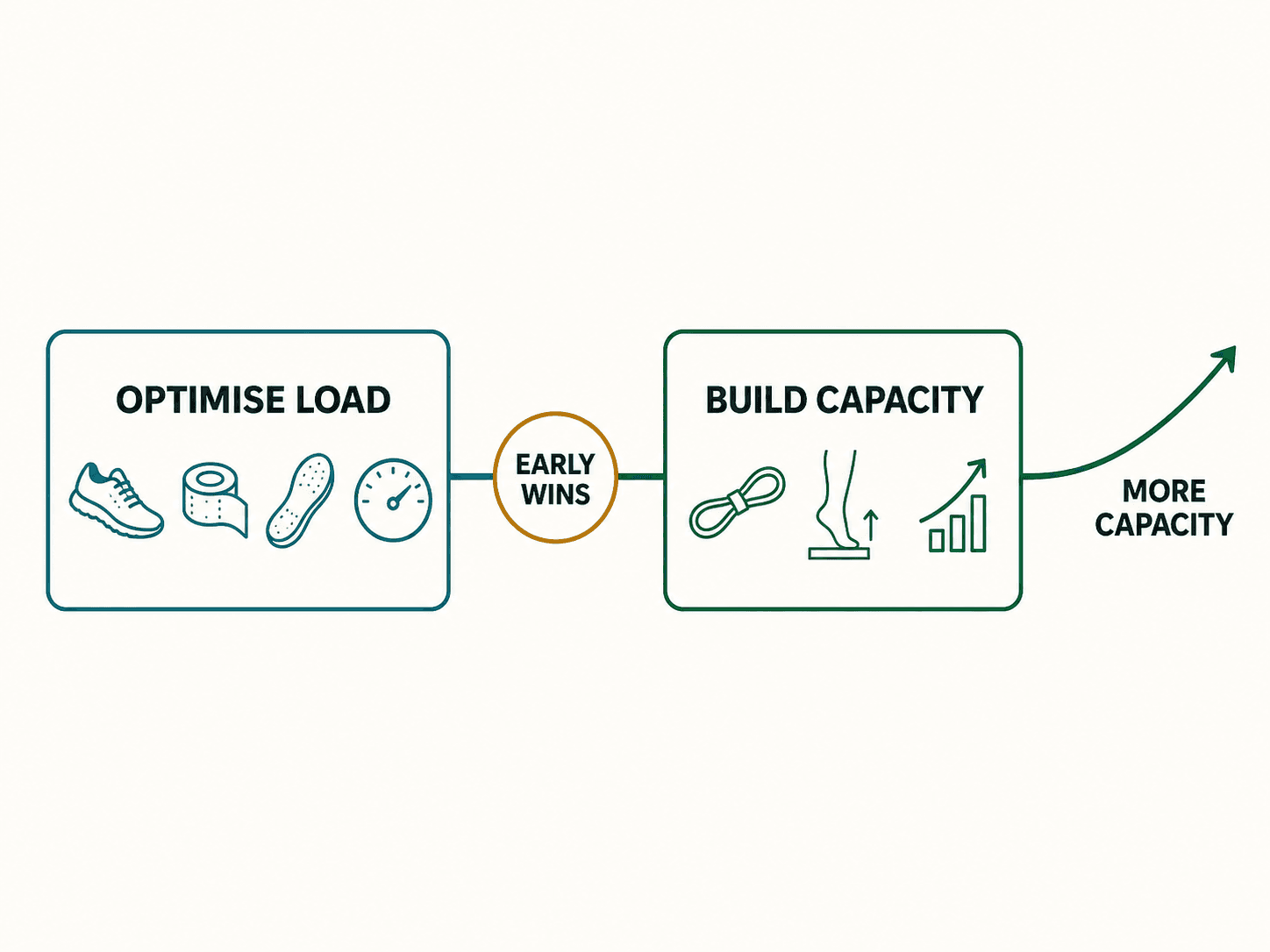
First, We Optimise The Load
Once we understand the load, the first job is often to make that load more tolerable.
Not remove it completely.
Optimise it.
Take the Achilles tendon or the plantar fascia. Both are structures that usually do better with the right kind of tensile load. Pulling load. Spring load. Load that helps them do their job.
But they can get grumpy when compression starts taking over.
That compression might happen when your heel drops too low. It might happen when your heel twists, inverts, everts, or rolls in a way that makes the tendon or fascia wrap, squash, or bend more than it wants to. It might happen as you walk, run, climb stairs, lift your heel, or push off through the forefoot.
This is where shoes, strapping, padding, heel lifts, and orthotics can be very useful.
Not because they magically fix the tissue.
Because they change the load.
A shoe with a little more pitch can change how much stretch and compression the Achilles has to deal with. A more stable shoe can reduce some of the heel twisting that keeps irritating the same structure. Strapping can temporarily change how the foot moves and how much stress goes through the plantar fascia. An orthotic can shift pressure, timing, or force so the sore tissue gets a more manageable job.
That can create an early win.
You can often keep doing more of your normal life while the most provocative stress is reduced. You might still walk to work, train in a modified way, get through a shift, or keep moving without poking the same sore spot in the same way every time.
This is why we do not think of shoes or orthotics as passive "supports".
They are load-shaping tools.
If they are useful, we should be able to explain the job they are doing. Less compression here. Less pressure there. A better angle. A calmer first step. A more tolerable push-off.
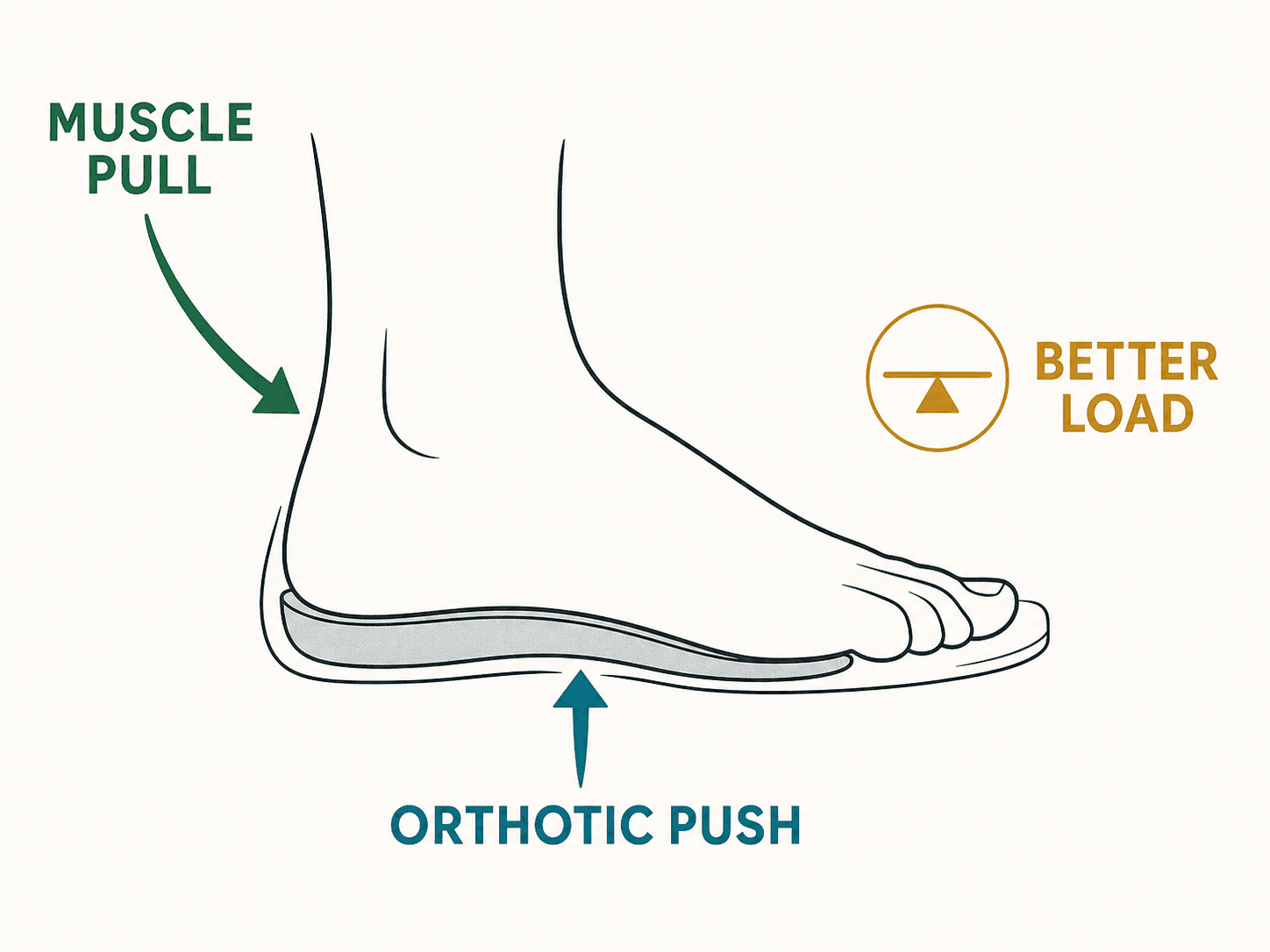
Often, the ideal version is that your muscles do the job themselves. A muscle pulls on the foot to control, stiffen, stabilise, or propel it. But if that muscle does not currently have enough capacity to pull well enough, we can sometimes complement it with a little push from an orthotic.
Not forever as a punishment.
Just enough to help you achieve the outcome while we work on the capacity underneath.
The goal is not to wrap you in cotton wool.
The goal is to change the load enough that your body can stop shouting and start adapting.
Then, We Build Capacity
Optimising the load can calm things down.
Building capacity is how we help your body do more.
This is the active part of the plan. We look at which tissues in the foot, ankle, calf, or leg need more strength, length, control, endurance, or tolerance. Then we choose the most useful way to train them.
Usually, that means resistance training.
Not random exercises. Not a list of movements copied from the internet. Not passive stretching because something feels tight and we need to do something that looks like rehab.
Exercises should have a job.
If your calf and Achilles system needs to tolerate running, hills, stairs, or jumping, we need to build the capacity for that kind of work. If the muscles that control your foot are not giving enough pull, we may need to strengthen them so the orthotic does not have to do as much of the pushing. If the tissues under your forefoot are sore because one small area is doing too much, we may need to change the load and build the surrounding system so it can share the job better.
The dose matters.
Too little and nothing changes. Too much and the tissue complains louder. The useful dose is the one your body can respond to, recover from, and gradually build on.
That is why the order matters.
Sometimes we need to change the load first so the exercises have a chance to work. Sometimes we can start building capacity immediately. Often, we do both: make life more tolerable now, then build the system so you can handle more later.
This Is How Pain Becomes A Problem We Can Solve Together
After years of working with foot, heel, Achilles, forefoot, ankle, and running injuries, one of the best parts of this job is seeing people realise their pain is not some mysterious life sentence.
There is usually a logic to it.
That does not mean it is always easy. Bodies are complex. Lives are busy. Pain can be frustrating, emotional, and stubborn. Sometimes there are factors we can change quickly, and sometimes there are factors we have to work around.
But the framework is simple.
What tissue is being loaded in a way it does not like?
What modifiable factors can we change?
How do we optimise the load so it starts getting less sore?
How do we build capacity so that tissue, and the tissues around it, can do more work in the future?
That is the process.
At first, you might need an external tool. A better shoe. Strapping. Padding. An orthotic. A heel lift. A change to your walking, running, training, or work setup.
That is not failure.
That is us changing the load so your body gets a better chance to settle.
Then we build. We strengthen. We dose the exercises properly. We progress what your body can handle. We help you become less reliant on the first thing that gave relief, because the real goal is not just a quieter foot.
The real goal is more capacity.
More confidence.
More trust in your body.
More ability to do the thing you came in wanting to do.
So if your pain has been making you ask, "what is wrong with me?", there may be a better question.
What is your body being asked to handle?
And how can we help it handle that better?
If your problem feels like plantar fascia or first-step heel pain, start with Heel Pain Reset. If it feels more like Achilles or tendon pain, start with Tendon Time. If you are unsure, or if pain is recurring, limiting your running, training, work, or confidence, that is where a proper Pride Podiatry assessment can help.
About The Author
Tim Mulholland is the Founder and Consultant Podiatrist at Pride Podiatry in Melbourne CBD. He works with heel pain, Achilles pain, running injuries, orthotic therapy, and exercise-based rehab.
His clinical work focuses on helping people understand why pain is happening, what can be changed, and how to build the capacity to do more.
This article explains the load and capacity framework Tim & the Pride Podiatry team use in clinic to make foot and ankle pain feel less random, less mysterious, and more solvable.
This article is general information and is not a substitute for an individual assessment. If pain is persistent, worsening, or limiting what you can do, a podiatry assessment can help clarify what is happening and what to do next.

Founder and Consultant Podiatrist at Pride Podiatry.